


Discover the best VPN for China 2026 and the complete China survival kit for Moroccan students. Learn how to access the internet, use Moroccan bank cards, set up Alipay for foreigners, and stay connected safely.
Finding the best VPN for China 2026 is one of the most important steps Moroccan students must take before studying or living in China. Unlike Europe or North America, China operates a tightly controlled internet environment that blocks many of the digital tools Moroccans rely on daily.
This article is designed as a China Survival Kit for Students, specifically tailored to Moroccan realities. It explains how to stay connected behind the Great Firewall of China, how to use a Moroccan bank card in China, how Alipay for foreigners works in 2026, and how students can avoid digital isolation during their first weeks.
Key Takeaways (30-Second Read)
China is digitally functional but restricted. Moroccan students who prepare properly experience smooth adaptation, while those who do not often struggle unnecessarily.
- Most Western apps are blocked without a VPN
- VPNs must be installed before leaving Morocco
- Moroccan bank cards now work with Alipay and WeChat Pay
- QR payments replace cash almost everywhere
- Arrival support can dramatically reduce first-week stress
Understanding the Great Firewall of China
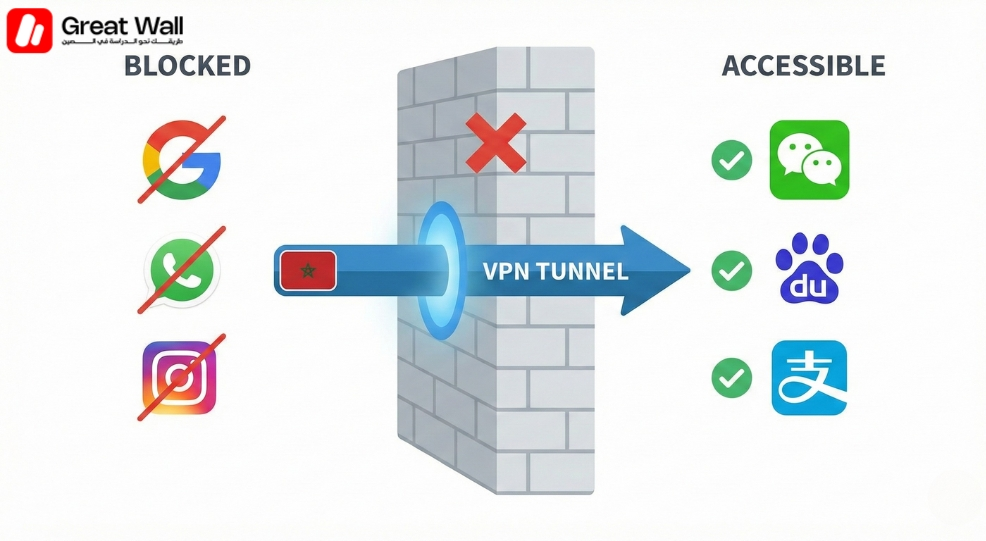
The Great Firewall of China is a nationwide system that filters and controls internet traffic. Its purpose is not to block foreigners specifically, but it does affect international students the most because many global platforms are inaccessible by default.
For Moroccan students, this means services like Google, WhatsApp, and Gmail will not function unless a working VPN is installed. This restriction affects not only communication, but also academic platforms, cloud storage, and even navigation tools.
Understanding this reality early allows students to prepare mentally and technically, rather than discovering it in panic after arrival.
Internet in China for Foreigners: What You Should Expect
Foreigners are allowed full internet access in China, but only within the Chinese digital ecosystem. International websites are limited, and speeds vary depending on location and provider.
Students usually rely on:
- A Chinese SIM card
- Dormitory Wi-Fi
- Public Wi-Fi in malls or campuses
However, without a VPN, these connections remain restricted. A properly configured VPN restores access to international services and allows students to continue using familiar tools without disruption.
Best VPN for China 2026: What Actually Works
Not all VPNs are equal in China. Many popular services function elsewhere but fail behind the Great Firewall due to aggressive filtering.
Based on student experience and long-term reliability, the following VPNs perform best in 2026:
- Astrill VPN, known for stability and advanced configuration
- LetsVPN, appreciated for simplicity and affordability
- ExpressVPN, reliable but more expensive
When comparing Astrill VPN vs LetsVPN, Astrill is generally better for long-term students who need consistent performance, while LetsVPN suits beginners or short stays.
Free VPNs are strongly discouraged. They are often blocked, slow, and may compromise data security.
Apps to Download for China (Before You Fly)
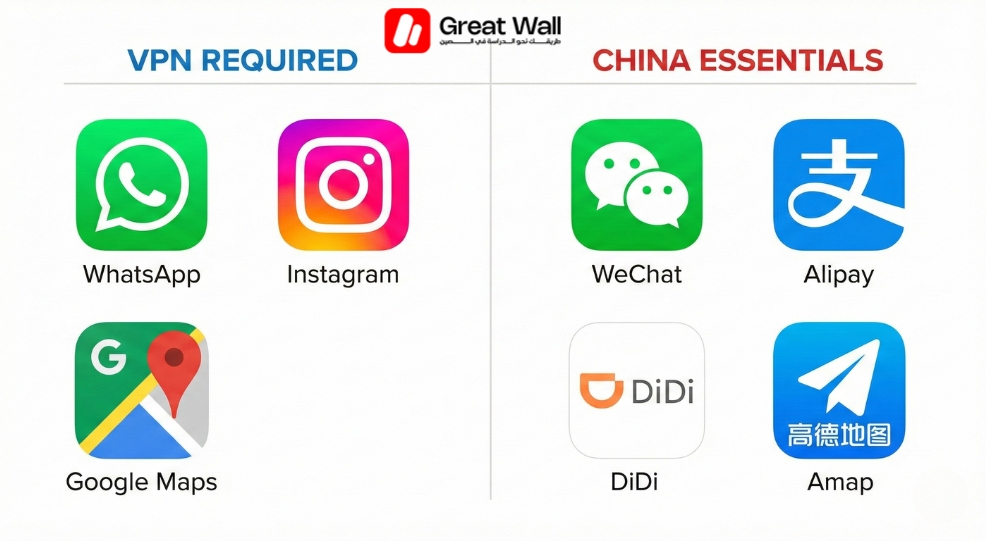
Many apps are difficult or impossible to download once inside China. Installing them beforehand ensures continuity.
Communication and productivity apps such as WhatsApp and Gmail require a VPN, while navigation tools like Apple Maps work without restrictions. For transportation, Uber does not operate in China; DiDi is the local alternative and supports English interfaces.
Students who prepare their phones and laptops in advance avoid unnecessary stress during their first days.
Planning your trip? Make sure you have everything else ready by checking [The Definitive China Application Checklist (Last Update 2026)].
Paying in China Without a Chinese Bank Account
China has transitioned into a nearly cashless society. Daily transactions are conducted through QR payments, even in small shops and taxis.
Alipay for Foreigners 2026
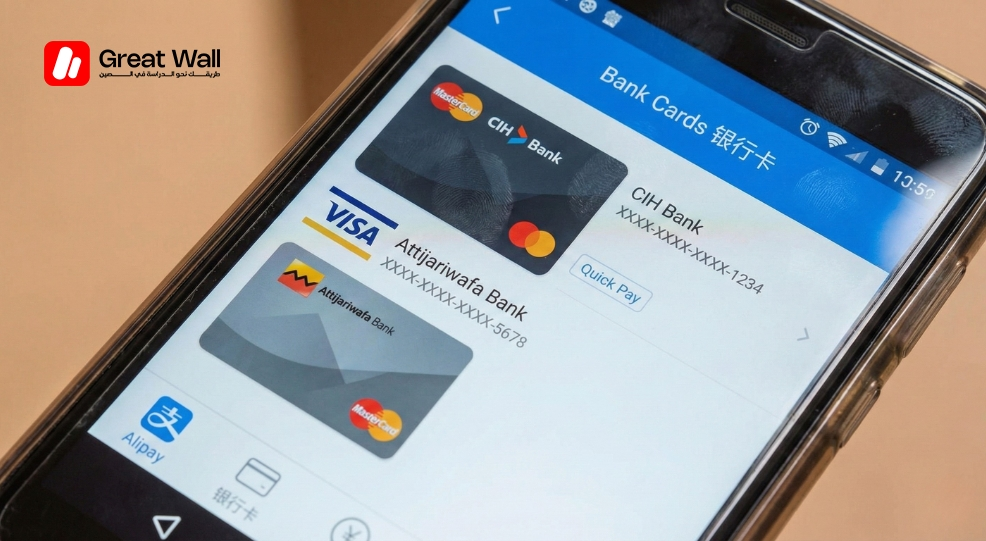
In 2026, Alipay allows Moroccan bank cards to be linked directly. This means students can:
- Pay for food, transport, and shopping
- Book train tickets and hotels
- Handle basic daily expenses without a Chinese bank account
Moroccan Bank Card in China
Cards from CIH, Attijariwafa Bank, and Bank of Africa are commonly supported, subject to Moroccan foreign currency limits (dotation touristique Maroc China). Testing card functionality before departure is highly recommended.
Worried about costs? Read our breakdown here: [Cost of Living in China: The 2026 Student Budget Guide].
WeChat Pay for Moroccan Students
WeChat Pay is deeply integrated into campus life. From cafeteria meals to dormitory services, many universities rely on WeChat’s payment system.
Moroccan students can link foreign cards or use WeChat Pay alongside Alipay. Using both platforms ensures broader acceptance and smoother daily transactions.
Quick Summary for Students
For Moroccan students, internet access in China requires preparation. Paid VPNs such as Astrill and LetsVPN allow access to Google, WhatsApp, and international services. In 2026, Alipay and WeChat Pay support Moroccan bank cards, enabling cashless payments without a Chinese bank account. Installing apps and VPNs before arrival and receiving local support greatly improves adaptation.
Common Digital Mistakes to Avoid
Many students face avoidable problems due to small oversights:
- Arriving without a VPN installed
- Relying on a single payment method
- Using free VPN services
- Ignoring cloud backups
Avoiding these mistakes significantly improves the China experience.
Conclusion: Preparation Creates Freedom
China is not restrictive by design for students; it simply operates differently. Those who prepare digitally experience freedom, independence, and confidence from the beginning.
You are not losing access; you are learning a new system. With the right tools and guidance, China becomes not only manageable, but comfortable.
Skip the Stress: How Great Wall Education Handles Your Digital Setup
Reading about China’s digital ecosystem is one thing; navigating it alone in a foreign language is another.
Most Moroccan students face a “Blackout Period” of 3–5 days upon arrival where they have no internet, no working bank app, and no way to contact home. We ensure this doesn’t happen to you.
Great Wall Education doesn’t just hand you a checklist. We provide physical, on-the-ground accompaniment to get you operational within 24 hours of landing.
1. The Banking “Fast-Track”: Chinese banks have strict compliance rules for foreigners. Going alone often results in rejection or limited accounts.
- What we do: We take you to foreigner-friendly branches (ICBC, Bank of China).
- The Result: We help you fill out the complex forms and ensure you walk out with a working Chinese bank card linked immediately to WeChat Pay and Alipay.
2. VPN & Internet Security: Net Did your VPN get blocked at the airport? Is the dormitory Wi-Fi refusing your connection?
- What we do: Our team verifies your connectivity on Day 1. If your primary VPN fails, we help you configure backup protocols that work specifically in your city.
- The Result: You can FaceTime your parents in Morocco the night you arrive.
3. Financial Integration (Morocco to China)
- What we do: We assist you in linking your Moroccan cards (CIH/Attijari) to Alipay for emergency funds while waiting for your scholarship or transfer.
- The Result: You are never stuck without money to buy food or water.
4. The “Survival App” Ecosystem: We don’t just tell you which apps to download; we show you how to use them.
- Setting up DiDi (so you don’t get scammed by illegal taxis).
- Configuring Meituan/Ele.me (so you can order halal food delivery).
- Navigating Taobao (to buy cheap dormitory supplies).

The “Great Wall” Difference
You are not just paying for university admission; you are investing in a smooth transition. While other students struggle to scan a QR code or unlock a SIM card, Great Wall Education students start their semester confident, connected, and secure.
FAQs
Yes. Paid VPNs restore full WhatsApp functionality.
Use Alipay or WeChat Pay with a Moroccan bank card.
There is no reliable free VPN for China.
Uber does not operate in China. DiDi is the local alternative.
We strongly advise against it. Even with a VPN, Google Maps data in China is years old and inaccurate. Use Amap (Gaode Ditu) or Apple Maps (if you have an iPhone) instead.
Yes. Your spending in China is limited to your annual foreign exchange allowance (Dotation Touristique) set by the Office des Changes (usually 100,000 DH/year for students, plus potential tuition payment allowances). Check with your bank before traveling.
References & Sources
- Ministry of Industry and Information Technology of China (MIIT). Official authority on internet regulation and telecommunications in China
https://www.miit.gov.cn/ - China Internet Network Information Center (CNNIC) National body publishing reports on internet usage and restrictions
https://www.cnnic.net.cn/ - Alipay – Official Foreign Card Support Page Explains how international cards work on Alipay (updated regularly)
https://global.alipay.com/docs/ac/foreign_cards - WeChat Pay – International User Guide Official documentation for foreign users and international bank cards
https://pay.weixin.qq.com/index.php/public/wechatpay_en - China Unicom – International Services. Information on SIM cards and mobile internet for foreigners
https://www.chinaunicomglobal.com/ - China Mobile – International Roaming & SIM Information
https://www.chinamobileltd.com/en/global/home.php - Astrill VPN – Official Website VPN provider widely used by international students in China
https://www.astrill.com/ - LetsVPN – Official Website VPN service designed specifically for restrictive networks
https://www.letsvpn.world/ - Apple Maps Availability in China (Apple Support) Confirms Apple Maps functionality without VPN
https://support.apple.com/en-us/HT202284 - DiDi Global – Official Website China’s main ride-hailing platform (Uber alternative)
https://www.didiglobal.com/ - Bank Al-Maghrib – Foreign Exchange Regulations Official source for Moroccan dotation touristique rules
https://www.bkam.ma/