

Can Moroccan graduates work in China without 2 years of experience? Yes. Discover the 2026 “Green Channel” rules, the Points System hack, and the new K-Visa for STEM talent.
Key Takeaways (Read in 30 Seconds)
- The “2-Year Rule” Myth: In 2026, you do not always need 2 years of work experience. Exceptions exist for Master’s graduates and STEM talent.
- The “Green Channel”: Master’s graduates from Chinese universities (80/100 avg grade) can apply for a Work Permit immediately.
- The Bachelor’s Hack: Bachelor’s degree holders can legally work if employed in specific Free Trade Zones (Shanghai, Hainan, Shenzhen).
- New for 2026: The “K-Visa” pilot program now allows top-tier STEM graduates to stay without a prior job offer in select cities.
- The Scorecard: You generally need 60 Points to qualify for a Class B Permit. Your age (18-25) and HSK 5 certificate are your easiest points.
Quick Answer
Can Moroccan students stay in China after graduation?
Yes, but there is no automatic “Post-Study Work Visa” for everyone. You must secure a job offer and convert your student visa (X1) into a Z-Visa (Residence Permit for Work). While standard rules require 2 years of experience, Moroccan fresh graduates can bypass this by:
- Obtaining a Master’s degree with high grades (80%+).
- Working in a designated “Free Trade Zone” (FTZ).
- Qualifying as “Innovative Talent” under the new 2026 STEM initiatives.
The “2-Year Rule” is Dead (If You Know the Secrets)
For years, the “2-Year Work Experience” requirement was the wall that forced thousands of international students to pack their bags. In 2026, that wall has doors.
China is in a global race for talent. The government realized that sending home fluent, educated foreign graduates was a waste. Before you even apply, understanding this long-term potential is crucial; as we highlighted in [Why Study in China? A Guide For Moroccan Students (2026)], the goal isn’t just a degree, it’s a global career.
Here are the three official ways you can stay legally immediately after graduation.
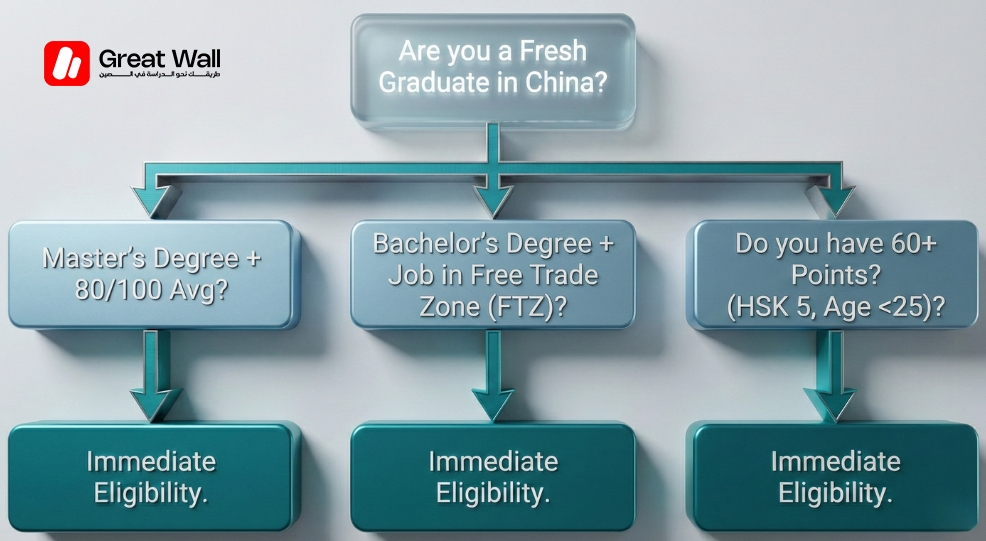
Pathway A: The “High Achiever” (Master’s Only)
This is the most direct route officially sanctioned by the Ministry of Human Resources and Social Security. You are exempt from the work experience requirement if you meet these conditions:
- Degree: Master’s Degree or higher from a Chinese University.
- Grades: An average score of 80/100 or above (Grade B).
- Employer: A job offer related to your major.
- University Letter: A “Letter of Recommendation” from your university (ask your ISO).
Pathway B: The “Free Trade Zone” Loophole (Bachelor’s Friendly)
Graduating with just a Bachelor’s? You can still stay, but location matters. China’s Free Trade Zones (FTZ), specifically in Shanghai (Pudong), Shenzhen (Qianhai), and Hainan; have special policies allowing Bachelor’s degree holders to work immediately.
- Strategy: If you are a Bachelor’s student, focus your job hunt exclusively on companies registered in these zones.
Pathway C: The Points System Hack
If you don’t fit A or B, you can “gamify” your way in using the Class B scoring system (detailed below).
Gamify Your Visa: The Class B Points System
China uses a scoring system to decide if you are “useful.” To get a standard Class B Work Permit, you need 60 Points.
Here is how a 24-year-old Moroccan fresh grad can hit 60 points without experience:
| Criteria | Your Status | Points Earned |
| Age | 18 – 25 years old (Youth is an asset!) | 10 Points |
| Degree | Master’s Degree | 15 Points |
| Chinese Level | HSK 5 or HSK 6 | 5 Points |
| University Rank | Top Chinese Uni (e.g., Zhejiang, Wuhan) | 5 Points |
| Annual Salary | 150,000 RMB+ ($21k USD/year) | 11 Points |
| Location | Working in a Tier-2 City or West China | 10 Points |
| Employment | Job Offer from a specific “Encouraged Industry” | 5-10 Points |
| TOTAL | 60+ Points (Passed) |
Insider Strategy: Notice how valuable language skills are? That extra 5 points often makes the difference between rejection and approval. This is why we argue that [Study Chinese Language: The “Foundation Year” is Your Hack]—it is the fastest way to secure that HSK 5 certificate before you even start your major.
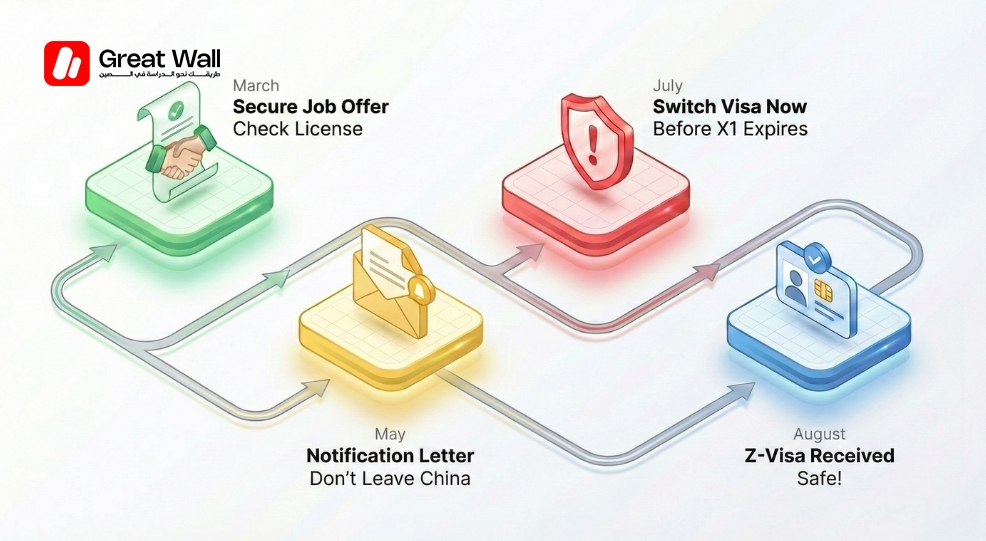
Step-by-Step: From Student (X1) to Professional (Z)
Crucial Warning: Do not let your Student Residence Permit expire. You must start this process 3 months before graduation.
- Step 1: Secure the Job Offer.
Ensure the company has the “Certificate of Authorization for Employment of Foreigners.” No license = No Visa.
- Step 2: The “Notification Letter.”
Your employer submits your documents (Diploma, Contract, Health Check) to the Bureau of Foreign Experts.
- Result: You get a “Notification Letter of Foreigner’s Work Permit.”
- Step 3: The “In-Country” Switch.
Take this letter to the Entry-Exit Administration Bureau. You apply to change your visa category without leaving China.
- Step 4: The Work Permit Card.
Pick up your physical Work Permit card (looks like an ID card).
- Step 5: The Residence Permit.
Your passport gets a new sticker: “Residence Permit for Work” (valid for 1 year, renewable).
Best Majors & Jobs for Moroccans in 2026
Your major must match your job title. You cannot study “Civil Engineering” and work as an “English Teacher.”
High Approval Majors:
- IT & Computer Science: Software developers are in critical shortage. Graduates from top technical schools often find placement easiest (See: [10 Best Universities for Computer Science in China]).
- E-Commerce & Trade: Managing supply chains for Moroccan/Arab markets.
- Mechanical/Civil Engineering: Companies working on Belt & Road projects (e.g., in Africa) need Arab-speaking engineers.
- Digital Marketing: Writing content for Chinese brands targeting the MENA region.
Low Approval Majors:
- Business Administration (Generic)
- Psychology / Sociology
- Political Science
Salary Expectations & ROI (2026)
Why fight for this visa? Because the savings potential beats Europe.
- Fresh Grad (Tech/Engineering): 12,000 – 18,000 RMB ($1,650 – $2,500).
- Fresh Grad (Sales/Trade): 8,000 – 12,000 RMB + Commission.
- Cost of Living: In a city like Hangzhou, rent + food is ~4,000 RMB.
- The Math: You can save $1,000+ per month. In France or Morocco, high costs often make this impossible for fresh grads.

Common Rejection Reasons (The “Red Flags”)
Why do Moroccan applications get denied?
- The “Fake Job” Scam: You pay an agency to “find” you a company to sponsor the visa, but you don’t actually work there. Consequence: Jail time and deportation.
- Low Salary: If a contract states a salary of 4,000 RMB, the bureau will reject it. It’s too low for a “foreign expert.”
- Job Irrelevance: A Medical graduate applying for a marketing job will be rejected.
Final Verdict: The “Plan B” Strategy
If you cannot secure a Z-Visa immediately, do not overstay.
- Apply for a “Stay Visa” (T-Visa): Some cities grant a 30-day “Humanitarian Visa” to give you more time to pack or travel.
- Return Home with Power: If you must return, you are not empty-handed. You are now a Mandarin-speaking expert. Use our guide on [Chinese Companies in Morocco: Job Opportunities] to find Chinese state-owned enterprises (like CRCC or Huawei) operating in Rabat and Casablanca that specifically hire China-graduates.
Frequently Asked Questions (FAQs)
People also ask about staying in China:
Generally, no. Unless you have a specific “Internship Annotation” on your residence permit, working is illegal. The “8-Hour Rule” for work-study is strict and requires university approval.
You must leave China or apply for a “Stay Visa” (T-Visa). This is a 30-day humanitarian visa that gives you extra time to pack or travel, but it does not allow you to work.
Yes. If you quit your job, your Residence Permit is canceled. You have roughly 30 days to find a new sponsor and transfer the permit, or you must leave the country.
Legally, you must have the Work Permit before you start probation. Working during probation without the permit card is a common trap that leads to fines.
References & Official Source
Authority Verification for 2026 Policies:
- State Administration of Foreign Experts Affairs (SAFEA):
- Evaluation Criteria for Foreigners Employed in China (Trial)
- Why this matters: This is the official document that defines the A, B, and C Class system and the specific point values for age, salary, and education.
- Ministry of Human Resources and Social Security (MOHRSS):
- Notice on Matters Relevant to Allowing Outstanding Foreign Graduates to Get Employment in China
- Why this matters: This is the “Green Channel” law. It explicitly states that Master’s graduates with an 80/100 average (or “B” grade) are exempt from the 2-year work experience requirement.
- Shanghai Municipal Administration of Foreign Experts Affairs:
- Shanghai Work Permit Guide & FTZ Policies
- Why this matters: Specific to the Shanghai Free Trade Zone (FTZ), this policy allows Bachelor’s degree holders to work immediately if employed by companies in designated zones like Pudong or Zhangjiang.
- National Immigration Administration (NIA):
- 5 New Measures to Facilitate Immigration and Entry-Exit (2024)
- Why this matters: These recent measures simplify visa extensions and allow foreign nationals to apply for port visas in urgent situations, providing a safety net for graduates.